What are the differences between different Jade?
On an afternoon in 1860, a French mineralogist stood in his Paris laboratory, gazing at a luminous green jade object looted from Beijing’s Old Summer Palace. His name was Alexis Damour, one of the most authoritative mineralogists in Europe at the time. Almost immediately, something struck him as wrong.
Three years later, after completing a series of chemical analyses, a startling truth emerged: the “jade” humanity had used for five thousand years was not one material at all, but two minerals with completely different chemical compositions. This discovery not only shook the scientific world—it fundamentally rewrote our understanding of one of humanity’s oldest gemstones.
Chinese Craftsmen Had Already Sensed It
Long before Damour uncovered this secret, Chinese jade craftsmen—masters of their material—had already sensed that something was amiss.
Some jade arriving from Burma (as Myanmar was then known) felt different: harder, denser, more responsive to carving, and capable of achieving a higher polish. Based purely on tactile experience, craftsmen began distinguishing between what they called “soft jade” (nephrite) and “hard jade” (jadeite).
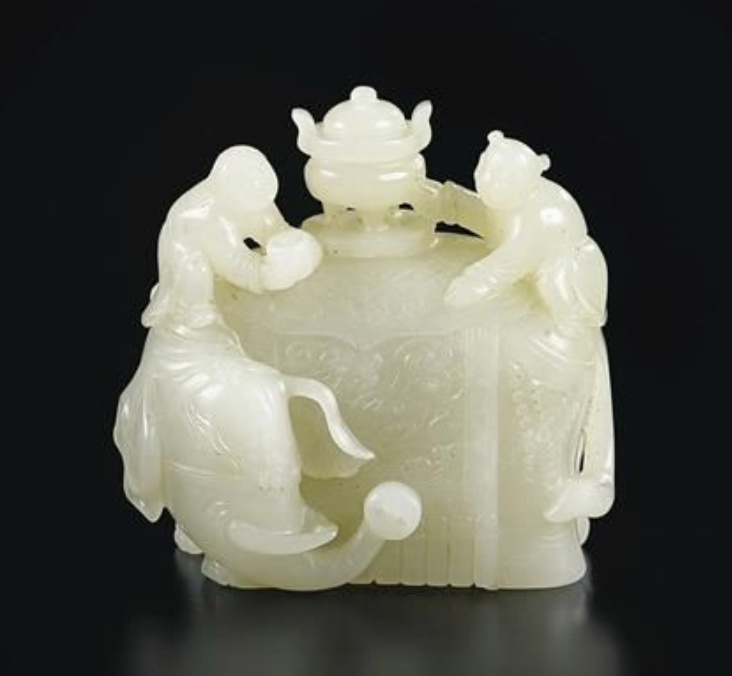
Nephrite
What they didn’t know was that the difference ran far deeper than hardness. One is a sodium-aluminum silicate, the other a calcium-magnesium-iron silicate; one belongs to the pyroxene group, the other to the amphibole group. In modern terms, their relationship is a bit like that of a horse and a zebra—similar at a glance, but genetically worlds apart.
Remarkably, even without chemical tools, Chinese craftsmen made the right economic choice: they were willing to pay more for Burmese “hard jade”(jadeite). Centuries later, science would confirm what experience had already taught them.
When “Jade” Was No Longer Just Jade
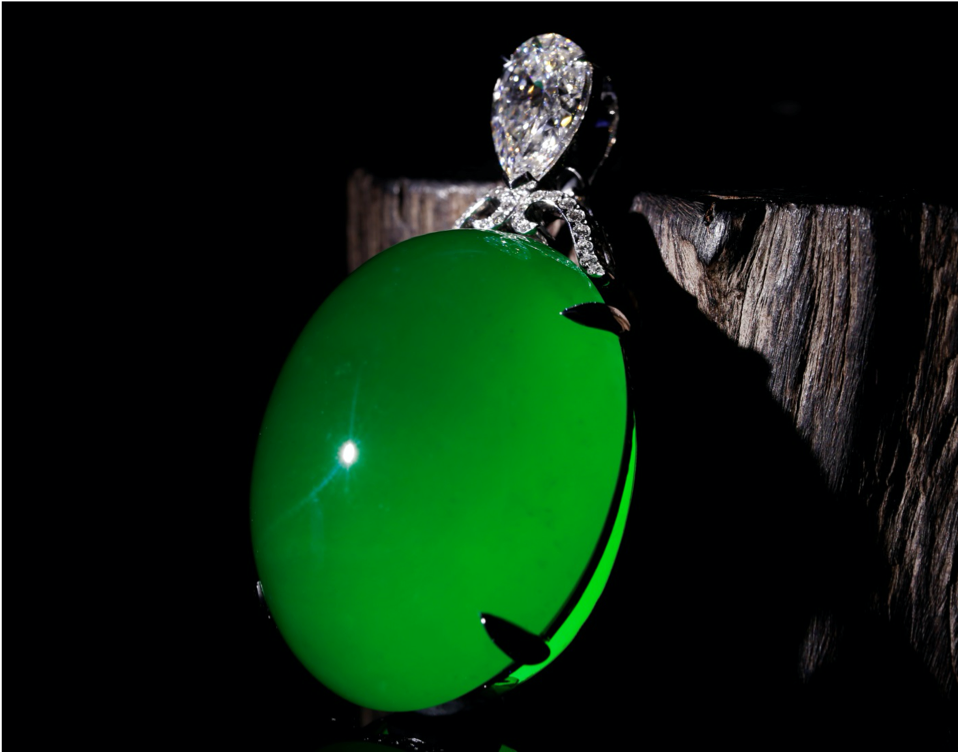
Jadeite
Before Damour, cultures around the world called anything that looked like jade simply jade—much as people once called all red gemstones “rubies.” The Chinese had carved ritual objects from nephrite for over four thousand years. In Mesoamerica, the Maya had been crafting masks and tools from jadeite for three millennia. Yet no one realized these civilizations were not using the same material at all. This confusion persisted until the 19th century. When Damour introduced the term “jadeite,” he wasn’t merely naming a mineral—he was dismantling a cognitive habit that had endured for thousands of years. From that moment on, the ancient word jade acquired clear scientific boundaries.
Jadeite Born Deep, Nephrite Near the Surface
If the Earth were a giant pressure cooker, jadeite and nephrite would be two dishes cooked under very different conditions.
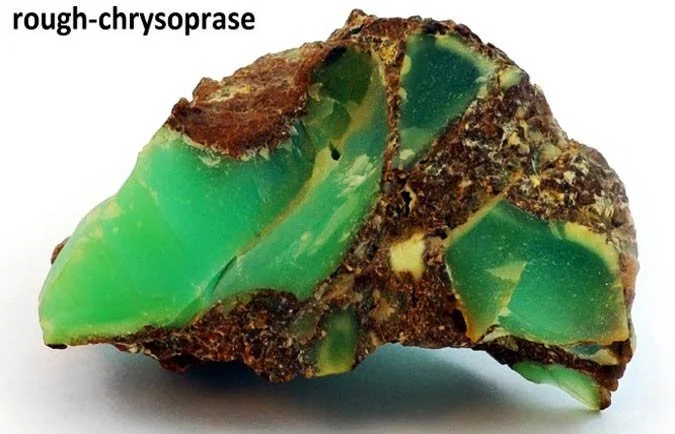
Jadeite
Jadeite forms deep within the Earth’s crust, under extreme pressure and relatively low temperature. These harsh conditions force its crystals into a tightly interlocking granular structure—like a towel twisted until not a drop of water remains. The result is a stone with a Mohs hardness of around 7, a density of 3.30–3.38, and a structure dense enough to transmit light. In high-quality jadeite, light seems to be stored inside the stone itself.
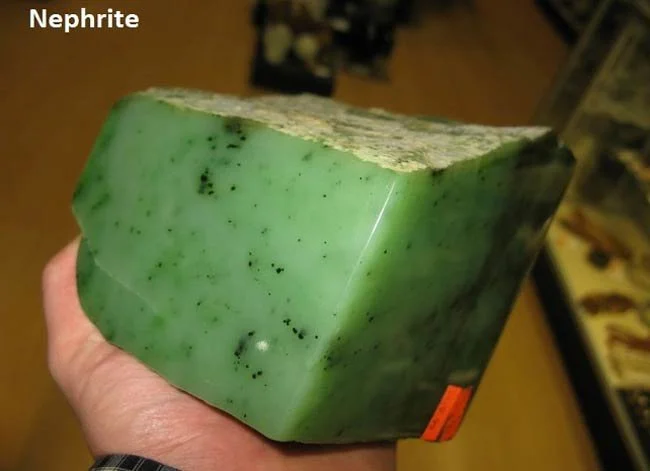
Nephrite
Nephrite, by contrast, forms under gentler metamorphic conditions. Its crystals grow into fibrous, felt-like structures that intertwine rather than compact. Its hardness is slightly lower (6–6.5), and its density lighter (2.90–3.03). But this fibrous structure gives nephrite a surprising advantage: extraordinary toughness.
That is why Neolithic people made axes from nephrite, and Māori warriors carved it into clubs. Not because it was harder—but because it was harder to break. You can scratch glass with jadeite, but drop both stones on the ground, and nephrite may survive intact while jadeite shatters.
One Dazzling, One Gentle
Standing before a jewelry display, even a non-expert can usually sense the difference.
Jadeite is expressive and bold. Its palette spills across white, apple green, pink, lavender, deep blue, orange, brown, and black. The most prized variety—imperial green—is a luminous, semi-transparent emerald green that seems to glow from within. Polished jadeite has a glassy, vitreous luster—bright, sharp, impossible to ignore.
Nephrite is restrained. Its colors hover around muted greens and greys, with occasional yellows, browns, and whites. The finest “mutton-fat jade” appears semi-translucent white to pale yellow, with a texture like congealed cream. Its polish produces a greasy or waxy luster—not dazzling, but deeply satisfying. Rather than reflecting light, it seems to absorb it.
If jadeite is a socialite in evening wear, nephrite is a scholar in plain robes—quiet, composed, and quietly dignified.
Burma’s Monopoly and the World’s Dispersion
Jadeite’s rarity is largely geographic.
Gem-quality jadeite is found in only a handful of places worldwide, and the most important by far is Myanmar. Burmese imperial green jadeite remains unmatched. Guatemala produces jadeite as well, but in smaller quantities and generally lower quality. Japan, Kazakhstan, California, and the Alps contain minor deposits, but none are commercially significant.
This near-monopoly keeps jadeite prices sky-high. Top-tier imperial green jadeite can fetch millions of dollars per carat at auction—sometimes exceeding the price of diamonds.
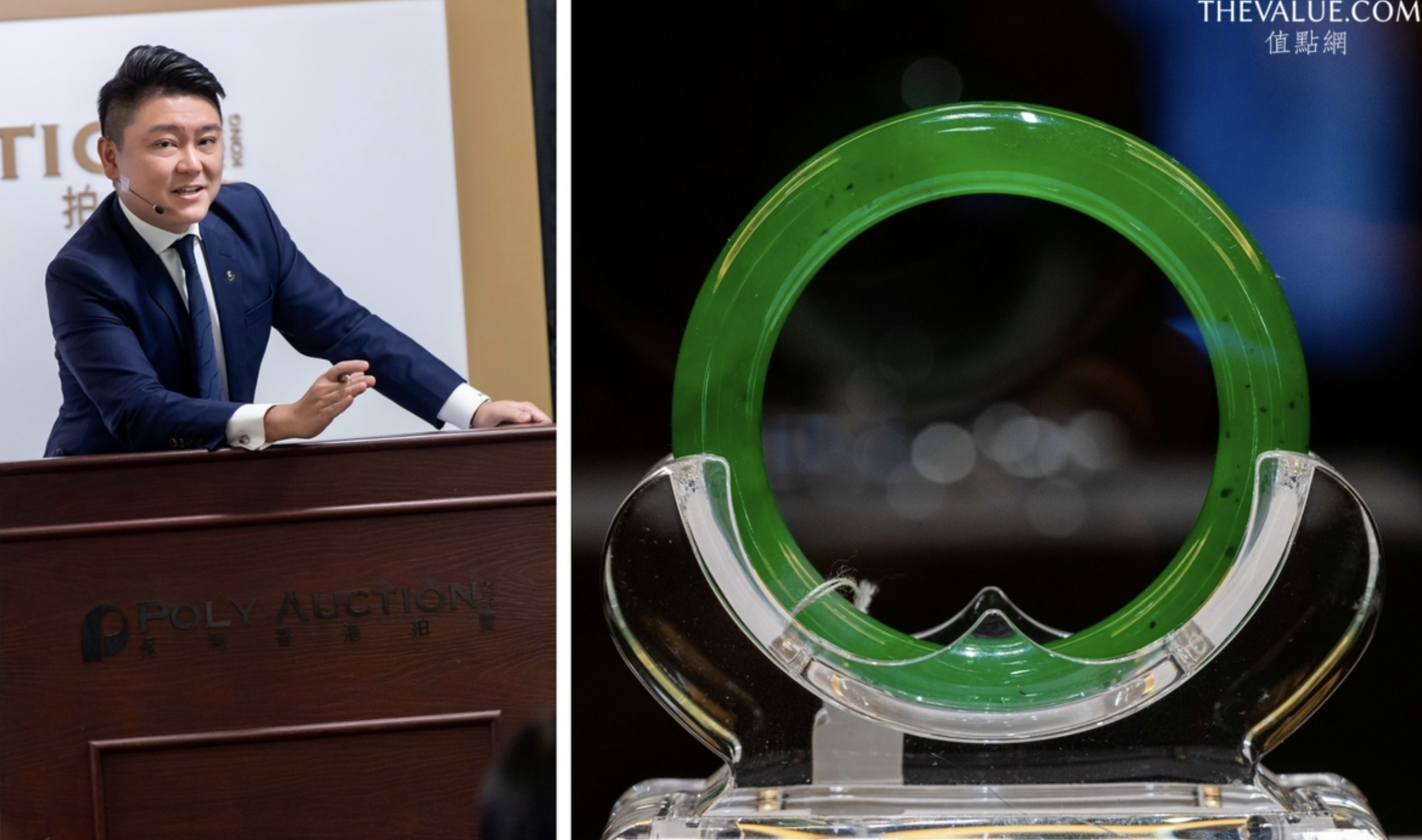
A jadeite bangle sold for €6.56 million at Poly Auction in Hong Kong, setting a new auction record. Photograpy: Justin Cheng
Nephrite, by contrast, is widely distributed: China, Canada, Russia, New Zealand, and the United States all have deposits. It often appears in riverbeds and coastal areas, requiring patience rather than deep mining. Nephrite is even the official gemstone of Alaska. Its abundance keeps prices far lower—often one-tenth that of jadeite.
Yet price does not equal value. In Chinese culture, nephrite’s status has never been diminished.
The East Chose Gentleness; the West Chased Light
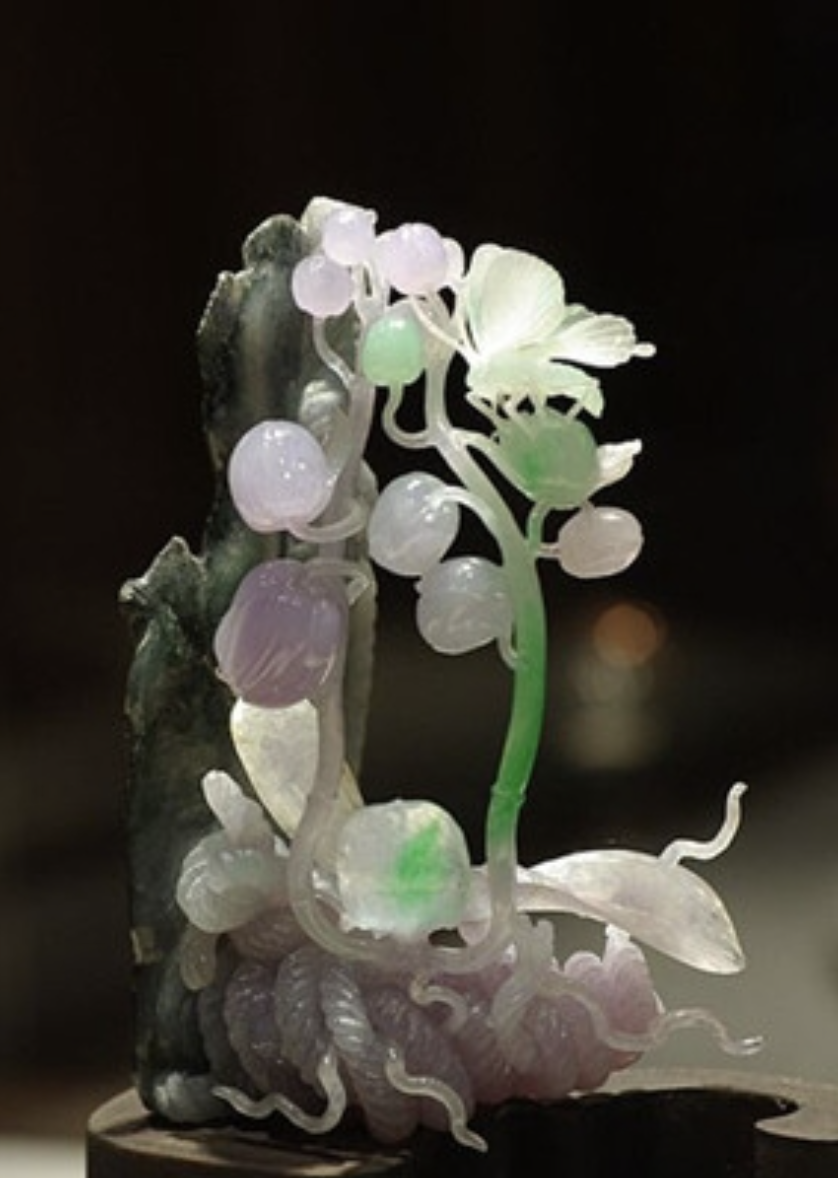
Jadeite Carving Art from Qing Dynasty
For millennia, nephrite lay at the heart of Chinese jade culture. Ancient Chinese believed it connected heaven and earth, calling it the “stone of heaven.” It symbolized virtue, purity, and moral integrity—the material embodiment of the gentleman. White nephrite, or mutton-fat jade, was revered by emperors and considered one of the rarest substances on Earth.
Jadeite entered China only in the 18th century, gaining favor for its vivid green. Yet even today, when Chinese collectors speak of Hetian jade, the reverence in their voices rivals that reserved for imperial green jadeite. This is not merely an aesthetic preference—it is a philosophical one. Where brilliance dazzles, restraint endures.
Across the ocean, Mesoamerican civilizations made the opposite choice. The Olmec, Maya, and Aztec had used jadeite since 1500 BCE, never encountering nephrite at all. To them, jadeite symbolized life and fertility and was more precious than gold.
The Spanish conquest ended this tradition abruptly. Conquistadors prized gold and emeralds, dismissing green stone as worthless. Jade carving vanished, and the mines were forgotten for five centuries—until 1974, when American explorers Jay Ridinger and Mary Lou Johnson rediscovered the lost jadeite sources in the Guatemalan jungle, reviving a broken lineage.
How Not to Be Fooled: A Few Simple Tests
When a jeweler presents you with a piece of “jade,” how can you tell what it really is?
Start with luster. Jadeite looks glassy and bright; nephrite looks oily and soft. Vivid color, translucency, and a vitreous shine often point to jadeite. Muted tones and a waxy glow suggest nephrite.

Hardness Scale
With tools, you can go further. Jadeite can scratch glass; nephrite often cannot. In a professional setting, immersion in methylene iodide (specific gravity ~3.0) will cause jadeite to sink and nephrite to float.
But these are only indicators. Reliable identification without instruments requires years of experience—perhaps explaining why humanity needed five thousand years to solve this puzzle.
For expensive purchases, insist on a gemological certificate from a trusted laboratory.
The Truth About Treatments
Most jadeite on the market today is not untreated.
Commercial jadeite falls into three categories:
Type A: Natural jadeite, only waxed.
Type B: Chemically bleached and polymer-impregnated—clearer, but structurally weakened.
Type C: Dyed jadeite, prone to fading and essentially imitation.
Type B and C jadeite dominate the market—even at high prices. A certificate matters. Without one, you may be buying a chemical experiment at gemstone prices.
Nephrite, by contrast, is rarely treated—one of its quiet advantages.
Which Should You Choose?
If you seek visual impact, rarity, and investment potential, jadeite is your stone. Top-grade imperial green jadeite is not just jewelry—it is a portable legacy.
If you value warmth, cultural depth, durability, and accessibility, nephrite will not disappoint. Fine Hetian or Canadian nephrite can be breathtaking, and its toughness makes it ideal for everyday wear.
Ultimately, jadeite and nephrite represent two philosophies of beauty: one celebrates brilliance and climax; the other honors continuity and presence. Which you choose depends on the life you wish to live.
Epilogue
When Damour published his paper in 1863, he likely did not realize he had uncovered more than a mineralogical distinction. He opened a window onto the deep aesthetic divide between civilizations.
The story of jadeite and nephrite is a story of choice—how different cultures, faced with two equally precious yet fundamentally different forms of beauty, chose differently and sustained those choices for millennia.
Today, as we finally understand their scientific differences, perhaps we can also appreciate this: whether it is the rare imperial green from Burmese mountains or the gentle white jade from the rivers of Hetian, both are gifts of the Earth. Neither is superior. One is simply more suited to you.
So the next time someone asks, “What kind of jade is this?”
You can smile and reply: First, we must ask whether it is jadeite or nephrite.
And then, if you like, you can tell them the story of this five-thousand-year identity puzzle.
